
Amplifier Tutorials
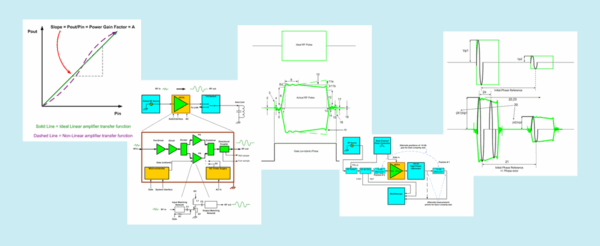
Table # 1 Pulse Parameter Definitions
|
Ref. |
Parameter name |
Description |
Dimension |
|
1,18 |
Ideal, zero volts reference line |
Mathematical construct, point of reference for all pulse voltages |
volts |
|
2,17 |
Blanked noise voltage |
Noise voltage out of RFPA when blanked |
volts |
|
3 |
Bias enable transient voltage |
Voltage spike exiting RFPA when RFPA is initially un-blanked pre-RF pulse |
volts |
|
4,15 |
Un-blanked noise voltage |
Noise voltage out of RFPA when un-blanked |
volts |
|
5 |
Pulse pre-shoot |
Amplifier output zero volt reference deviation prior to pulse rise |
% |
|
6 |
Pulse rising edge |
10-90% voltage transition range |
volts |
|
7 |
Pulse rise transition duration |
Time required for amplifier to transition from 10-90% of peak output voltage |
micro/nano-seconds |
|
8 |
Rising pulse overshoot |
Portion of RF pulse that exceeds 100% amplitude during post rising transition duration |
% |
|
9 |
Pulse overshoot ringing/decay time |
Time for damped sinusoidal envelope peak to decay |
micro/nano-seconds |
|
10 |
100% pulse RF amplitude reference |
Point on RF pulse that is chosen to be 100%, usually after overshoot and ringing are done |
volts |
|
11a,b |
Pulse tilt positive/negative |
Amount that peak RF voltage slopes throughout pulse width duration |
% |
|
12 |
Pulse falling edge |
90-10% voltage transition range |
volts |
|
13 |
Pulse falling transition duration |
Time required for amplifier to transition from 90-10% of peak output voltage |
micro/nano-seconds |
|
14 |
Post pulse backswing |
Amplifier output zero volt reference deviation after pulse fall time |
% |
|
16 |
Bias disable transient |
Voltage spike exiting RFPA when RFPA is blanked post-RF pulse |
volts |
|
19 |
Falling pulse overshoot |
Portion of RF pulse that exceeds final tilt amplitude pre-falling transition duration |
% |
|
20 |
AM-AM distortion |
Inter-pulse amplitude ratio distortion, also known as gain linearity |
db |
|
21 |
AM-PM distortion |
Inter-pulse relative phase distortion, also known as phase linearity |
degrees |
|
22 |
Amplitude stability |
Long term gain stability over time |
db/hours |
|
23 |
Phase stability |
Long term phase stability over time |
degrees/hours |
|
24 |
Phase-error, over-pulse |
Phase shift across the duration of a pulse width |
degrees |
